
Last updated
12 min readrenovationRenovate or move? The Bulimba calculation most owners miss
A $2.3M Bulimba purchase carries roughly $105,600 in QLD stamp duty under the home concession (QRO, 2026), plus selling and buying agent fees of $30,000–$60,000 — frequently more than a structural renovation funded via equity release, before counting moving costs or losing the school catchment. Three renovation scopes (cosmetic, extension, full Queenslander) compare differently.
The short version (TL;DR)
Upgrading from a $1.6M Bulimba house to a $2.3M Bulimba house carries roughly $105,600 in QLD owner-occupier stamp duty under the home concession (Queensland Revenue Office, transfer duty rates, live page) plus selling agent fees ($30,000–$50,000 at typical Brisbane commissions on a $1.6M sale) plus buying-side legal and conveyancing. Total transaction cost: $140,000–$170,000 before a single internal wall is touched on the new property. A substantial renovation on the existing property — funded through an equity release against the current home's value — frequently costs less while preserving the school catchment, the established garden, and the postcode-tied capital growth pattern. Three renovation scopes (cosmetic, structural extension, full Queenslander) compare differently against the move calculus.
If a renovate-vs-move decision is on the table, a 30-minute coffee is the cheapest way to map the actual numbers against the family's specific situation.
The plain English version
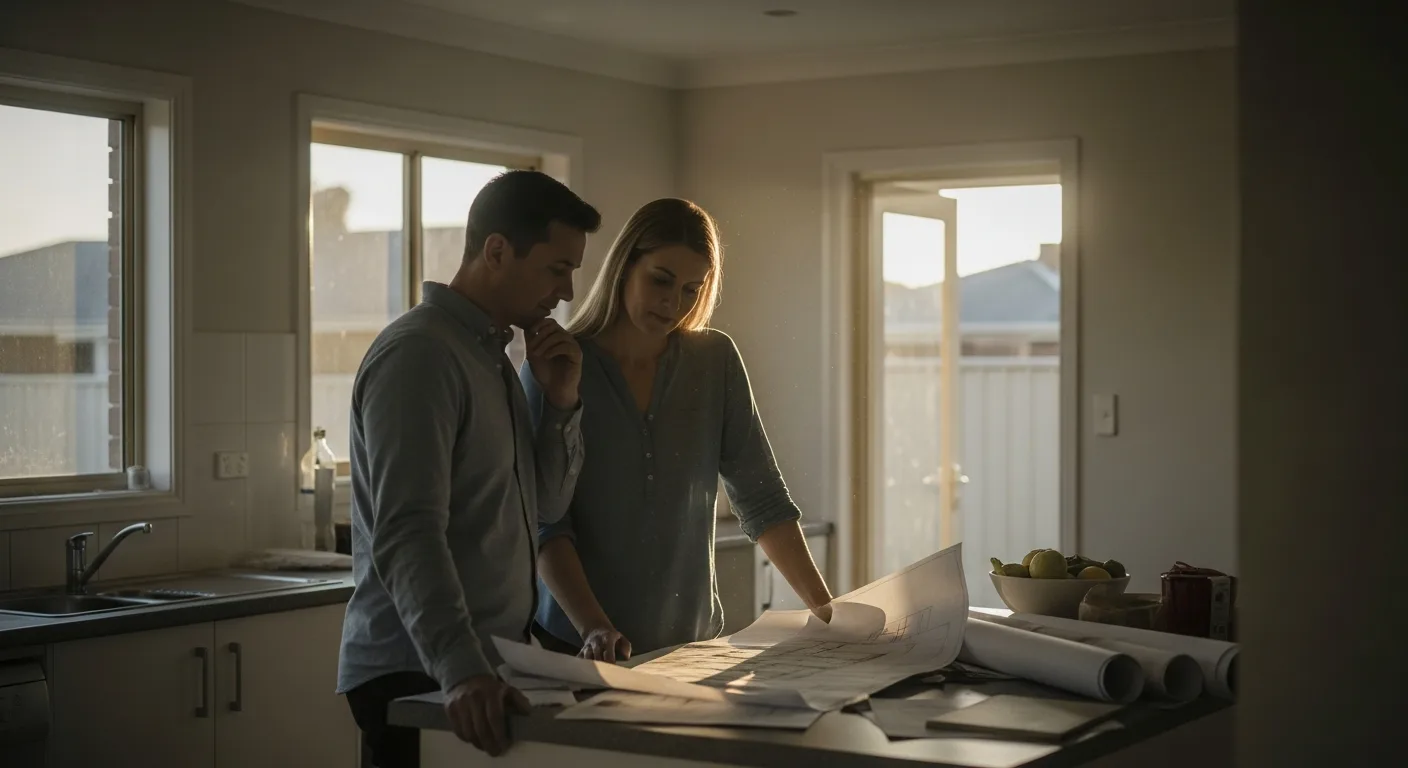
The "we've outgrown this house" conversation usually starts with a property listing and ends with a calculation. The calculation that's missed most often: how much of the upgrade budget gets eaten by transaction costs that produce nothing structural for the family.
What the move actually costs
Stamp duty on a $2.3M owner-occupier purchase in QLD with the home concession applied lands at approximately $105,600 (QRO transfer duty rates page, live as at April 2026; without the home concession the figure would be $112,775).
Selling agent commission on the existing $1.6M home typically falls between 1.8% and 2.5% in inner Brisbane — call it $30,000–$40,000. Marketing budgets for a campaign add another $5,000–$10,000. Buyer's-side conveyancing, building and pest, transfer fees and lender legal add roughly $3,000–$5,000.
Total transaction cost on the move: $140,000–$170,000 before furniture is shifted.
What an equity-funded renovation costs
A substantial renovation — extension to a Queenslander, kitchen and bathroom replacement, a new master suite — typically falls in the $250,000–$600,000 range in current Brisbane build pricing depending on scope. Funded by an equity release against the existing home's value rather than fresh deposit savings, the immediate cash impact is the construction-loan interest service plus the renovation itself.
The structural difference: every dollar spent on the renovation produces a square metre of usable space the family keeps. Every dollar spent on stamp duty and agents produces neither.
The school catchment and the postcode
Two non-financial factors that quietly tilt the maths:
- School catchment: Bulimba State School (and the catchment cutoffs around it) reset on a property-address basis. A move within the suburb may keep the catchment; a move outside doesn't.
- Postcode capital growth: Bulimba has shown strong long-term price growth (Cotality Home Value Index, April 2026). The household that moves out of postcode 4171 is opting out of that growth; the household that renovates and stays continues to capture it.
If a family is working through the trade-off, the first conversation is free.
The detail (for those who want it)
The full transaction-cost stack on a $1.6M → $2.3M move
A worked example for a Bulimba upgrade. The numbers come from the QRO calculator (live), typical Brisbane agency commissions, and standard buyer-side cost ranges.
Buyer side — $2.3M purchase (owner-occupier, home concession applied):
| Item | Amount |
|---|---|
| QLD stamp duty (home concession) | ~$105,600 |
| Mortgage registration + transfer fees | ~$300 |
| Conveyancing | $1,500–$2,500 |
| Building + pest inspection | $500–$800 |
| Lender legal | $500–$900 |
| Buyer subtotal | ~$108,600 |
Seller side — $1.6M sale:
| Item | Amount |
|---|---|
| Selling agent commission (1.8–2.5%) | $28,800–$40,000 |
| Marketing campaign | $5,000–$10,000 |
| Conveyancing (sale side) | $1,200–$2,000 |
| Discharge fee on existing mortgage | $300–$500 |
| Seller subtotal | $35,300–$52,500 |
Soft costs:
- Removalists for a Bulimba-to-Bulimba house move: $2,000–$5,000 depending on volume
- Utility connection / disconnection fees: $200–$400
- New blinds, light fittings, immediate repairs the building report flagged: $5,000–$15,000 commonly
Total all-in: $151,000–$181,000 depending on agent margin, build report findings, and how much the family does itself.
The renovation comparison
Construction pricing in Brisbane in 2026 sits well above its 2019 baseline, but the relative comparison still favours renovation in many situations. Three renovation scopes:
Cosmetic refresh — kitchen, bathrooms, paint, flooring, landscaping. Typical cost: $80,000–$180,000. Funded entirely from a $200,000 equity release at standard variable home loan rates (RBA Lenders' Interest Rates F-series — average outstanding owner-occupier variable rate sits at 5.73% as at February 2026). Adds 10–25% to property value typically; less than the spend on a 1:1 basis but real.
Structural extension — new master suite, second-storey addition, opening up the rear of the house to a deck. Typical cost: $250,000–$500,000. Construction-loan structuring becomes relevant here (see the construction loans piece for the lender-side detail). Adds 30–60% to property value commonly when the extension solves a real layout problem.
Full Queenslander renovation — restump, rewire, replumb, re-roof, new kitchen, new bathrooms, possible second-storey, full landscape. Typical cost: $500,000–$1,200,000. Comparable to the upgrade-house transaction-cost stack on its own; produces a structurally renewed house in the same postcode.
Where renovation doesn't suit
The renovate-vs-move comparison isn't always tilted toward renovation. Cases where the move is the better call:
- The existing house can't physically accommodate what's needed — heritage overlay restricts the addition, the lot is too narrow for the second-storey extension, the structural condition rules out cost-effective work
- The family's location needs are changing — closer to the city, closer to a different school, closer to elderly parents
- The current property has a structural defect that's expensive to remedy and not covered by the renovation budget
- Equity isn't available — the existing loan is sitting at high LVR and there's no buffer to fund the renovation through equity release
For most Bulimba families thinking about moving up the property ladder within the same suburb, the structural defect or location-need cases don't apply. The default question becomes: is the renovation budget large enough to address what the family wants, and does the existing property's structure support it?
How equity-released renovations actually work
The lender side of an equity-funded renovation has a few moving pieces worth understanding:
- Valuation against current value — the lender orders a valuation of the property as it stands today. The available equity is a percentage of that value (typically 80% LVR less existing mortgage balance).
- Loan structuring — for a cosmetic refresh, a single increase to the existing loan or an offset-account-funded redraw may suit. For structural work, a separate construction loan with progress payments aligned to builder milestones is the standard approach.
- Serviceability re-assessment — lenders re-test the borrower's ability to service the larger combined loan against current income. Income documentation requirements depend on whether the borrower is PAYG or self-employed.
- Heritage and character overlay considerations — Bulimba's older Queenslander stock sits within Brisbane City Council's traditional building character zones. Some lenders apply additional scrutiny to character properties. Pre-approval on the renovation needs to factor the overlay status before the architect is engaged.
The honest framing
The decision isn't "renovation good, move bad" or vice versa. It's "what does the family actually want over the next 5–10 years, and which path produces that outcome with the least money spent on transaction friction?"
For families happy in their suburb, attached to their school catchment, and with a property that can structurally absorb the work they want done, renovation usually wins on pure economics. For families whose needs have outgrown the suburb itself, no amount of renovation closes that gap.
A 30-minute coffee can map the renovate-vs-move maths against the actual numbers — current loan, current equity position, what the family wants to do, what each lender's appetite for the renovation pathway looks like. Book one with Danny or call him on 0423 161 855.
More from Danny



Danny Naidoo
Danny Naidoo, Credit Representative under Australian Credit Licence 486112, mortgage broker in Bulimba, Brisbane.
Want to talk about this?
Thirty-minute first conversation, no obligation. Coffee on Oxford Street or video — whatever suits your week.
Book a coffee with DannyOr read more about Danny as a Bulimba mortgage broker.